CogniGraphv2
Open the app

Cognitive neuroscience, in your browser

A 3D brain you can look inside.

Replay eight everyday moments region by region. Knock out a region and see what breaks. Run 150 spiking neurons live. Every step says how well it is supported.

No account. No API key for the core experience.
Educational simulation, not medical software.

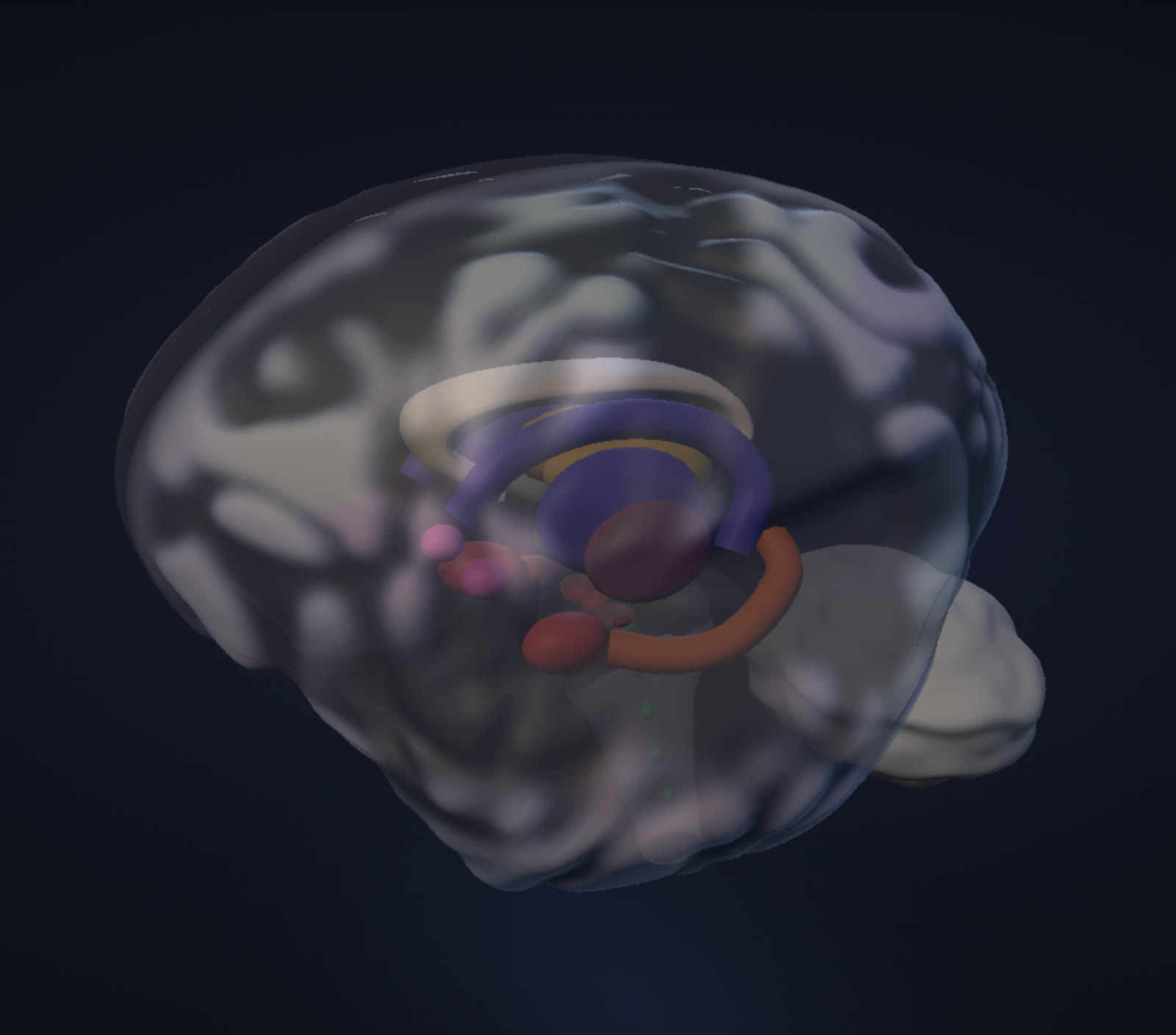
The CogniGraph brain: a translucent grey cortex with the thalamus, hippocampus, amygdala and basal ganglia visible inside in purple, orange and red, and the cerebellum behind.
Procedural geometry, rendered live in WebGL

Replay · Recognizing a face

t = 0 ms

  1. Step 1~55 ms
    V1primary visual cortex

    Edges, contrast and orientation are pulled out of the image.

    Human recording

  2. Step 2~95 ms
    V4ventral stream

    Colour and mid-level shape lift the face off the background.

    Animal model

  3. Step 3~170 ms
    FFAfusiform face area

    The face is encoded as a whole, apart from other objects.

    Human recording

  4. Step 4~300 ms
    Hippocampus + amygdala

    The face is matched to a person and to how you feel about them.

    Estimate

  5. Step 5~400 ms
    vmPFC / OFC + dlPFC

    You decide what to do about it.

    Estimate

One of the eight pathways, with the app's own timings and evidence badges. Millisecond values are group averages from the literature, not measurements of anyone in particular.

The tour

Forty-six seconds, no sound.

Pathways, Atlas, Neurons, Scenario and Learn, in the order you meet them in the app.

Silent by design. Nothing plays until you press play.1080p · 46 s · captured from the live app

Five ways in

Pick a moment. Or a region. Or a single neuron.

The same brain, five modes. Each one is a different question you can ask it.

  1. Pathways1
  2. Atlas2
  3. Neurons3
  4. Scenario4
  5. Learn5
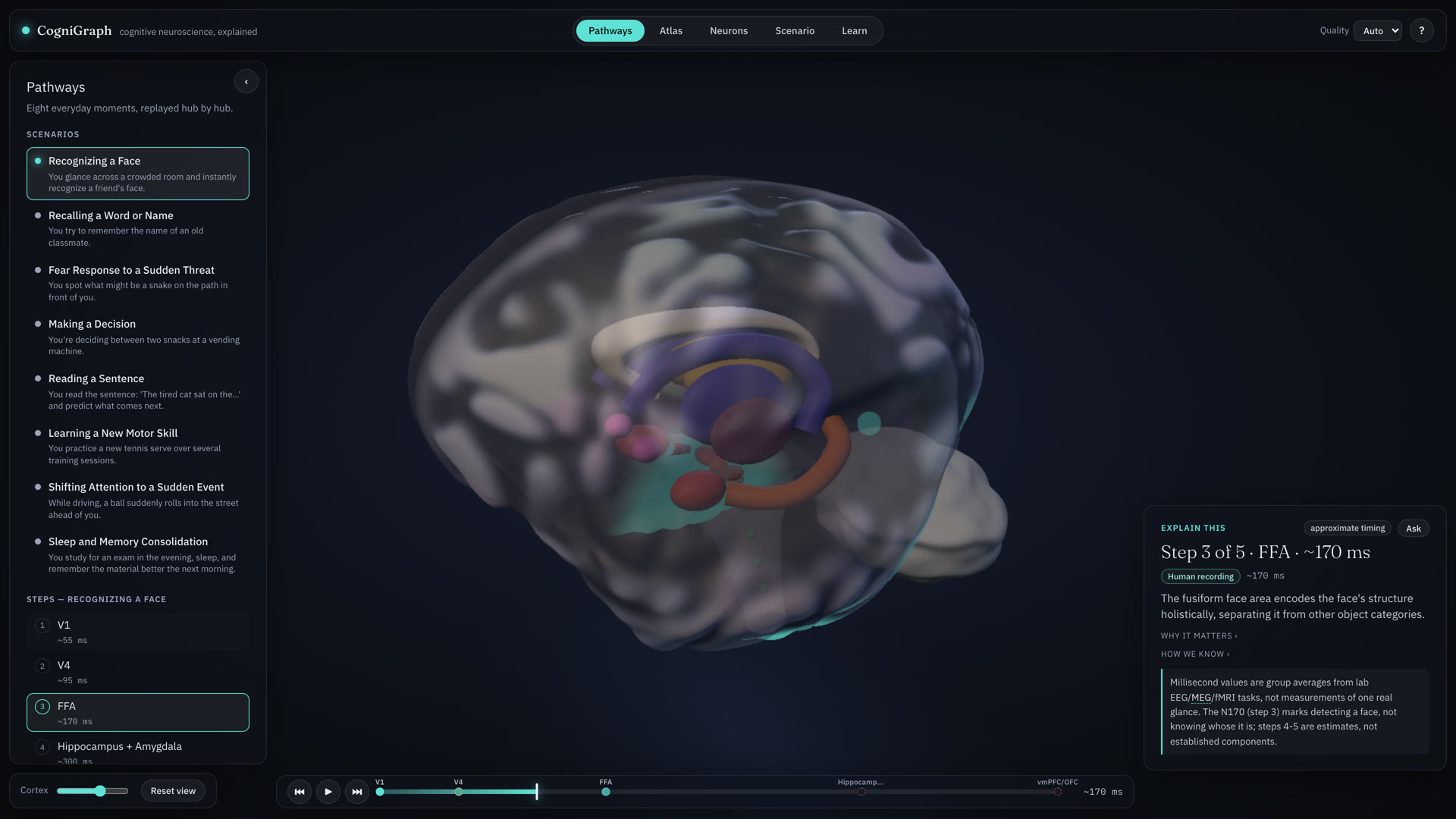
Pathways mode: the brain with the fusiform face area lit in teal, a timeline at the bottom and a step card reading Step 3 of 5, FFA, about 170 ms, tagged Human recording.

Pathways

Eight everyday moments, replayed hub by hub.

Recognising a face, recalling a word, a fear response, making a decision, reading a sentence, learning a motor skill, shifting attention, sleep consolidation. Each step opens with one sentence, the reasoning and the evidence behind it. Motor learning and sleep consolidation unfold over much longer timescales and are marked schematic.

There is also a 24-trial Stroop task, about a minute long, so you can put your own reaction time next to the timeline. It runs and stays on your device.

Try

Press space to play. Click a timeline marker to jump to that step.
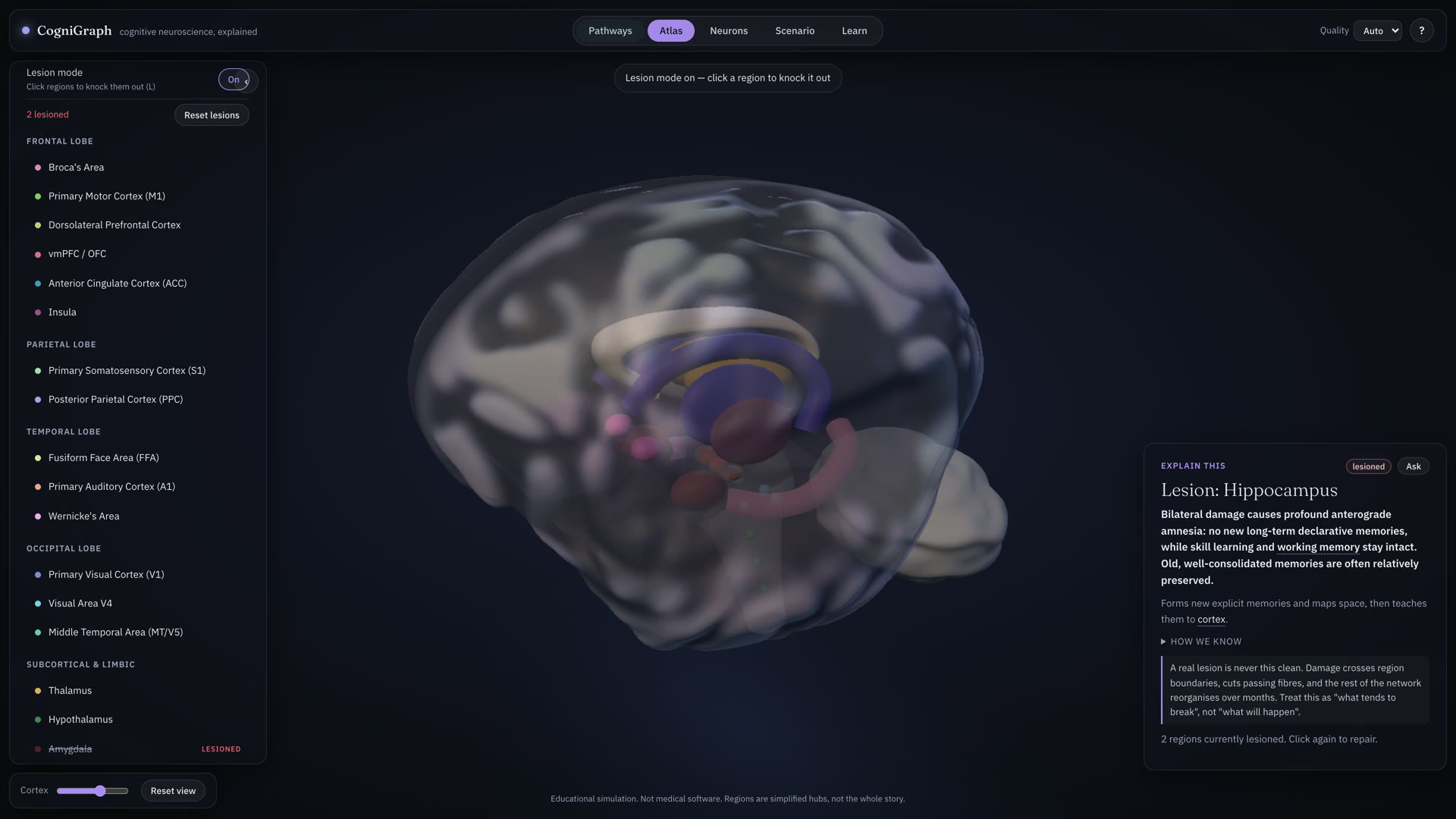
Atlas mode with lesion mode on: the region list grouped by lobe, two regions marked lesioned, and a card titled Lesion: Hippocampus describing anterograde amnesia.

Atlas

28 regions, and what breaks without them.

Thirteen cortical patches and fifteen modelled structures: what each does, what it connects to, and the famous cases. Turn on lesion mode, knock a region out, then go back to a pathway and watch the steps that needed it get marked broken.

Try

Lesion the hippocampus, then replay Recalling a word or name.

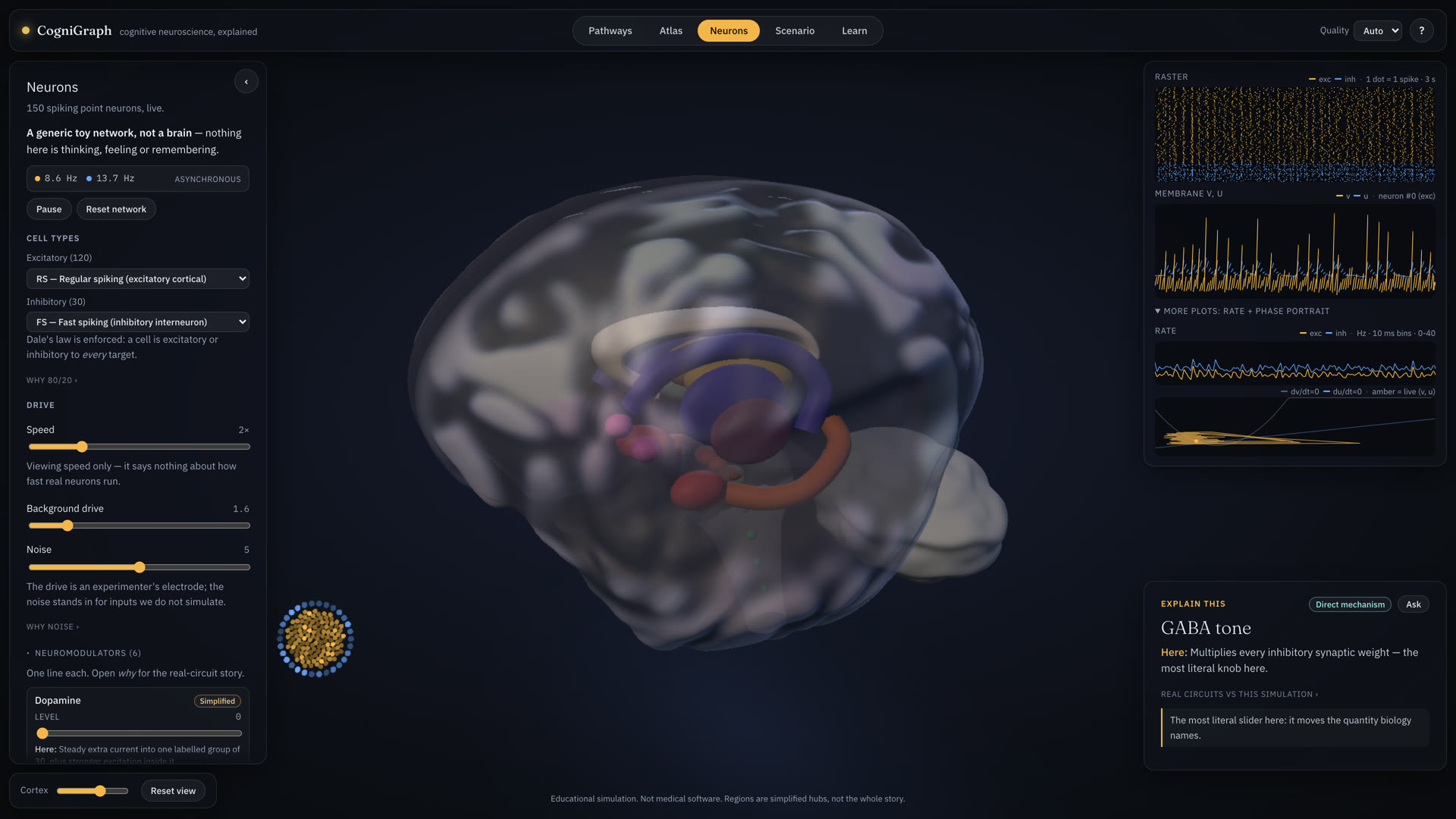
Neurons mode: a spike raster and membrane-voltage traces in amber, cell-type and drive controls on the left, and a card explaining the GABA tone slider, tagged Direct mechanism.

Neurons

150 spiking neurons, live.

An Izhikevich point-neuron network: regular-spiking excitatory cells and fast-spiking inhibitory cells, with the raster and membrane traces on screen as it runs. Six neuromodulator sliders each say exactly what they change in the model and how well that mapping is supported. It is a toy network, not a brain, and the panel says so.

Try

Drag a slider. The badge next to it tells you how literal that knob is.

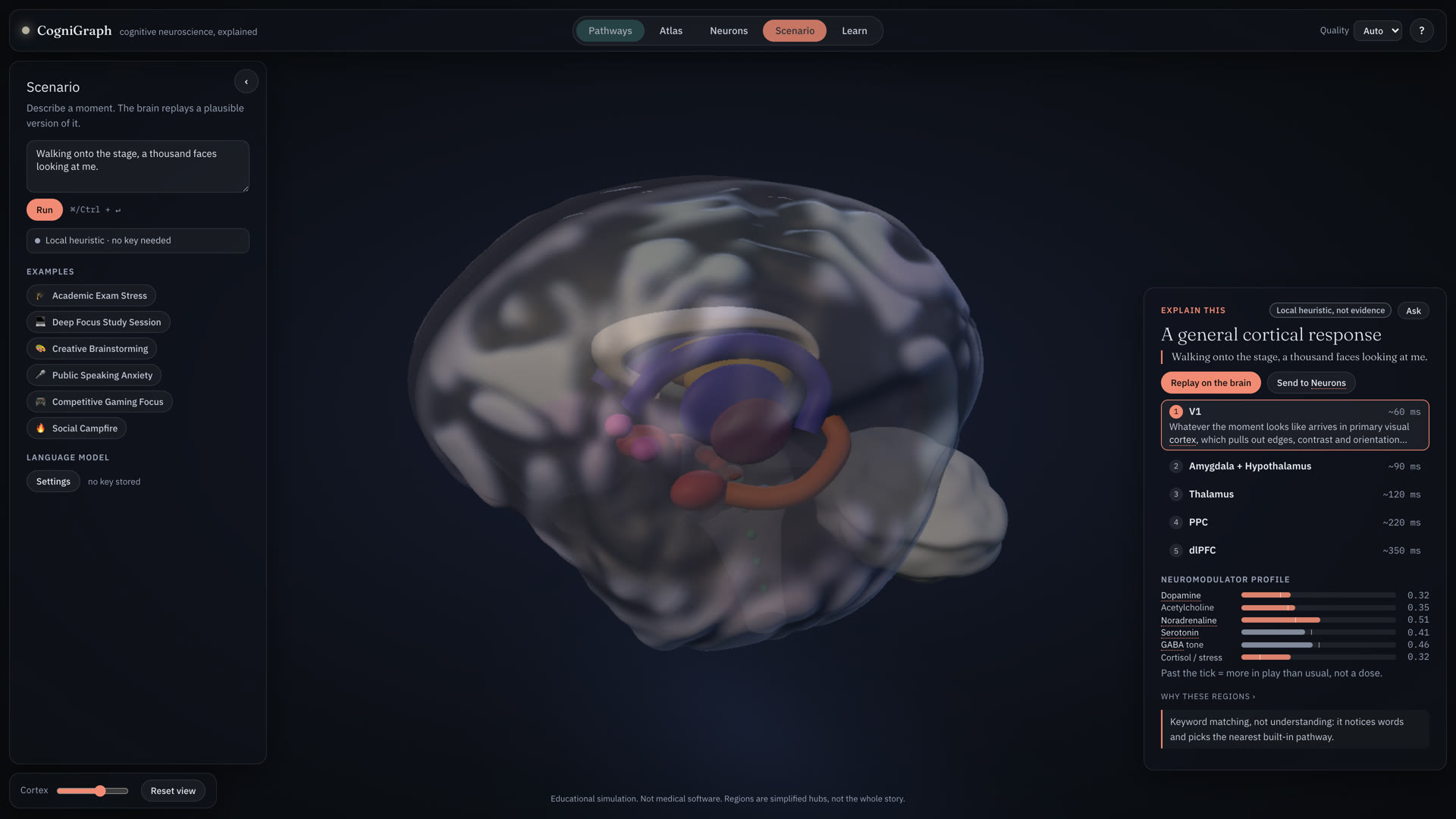
Scenario mode: the sentence Walking onto the stage, a thousand faces looking at me, a result card titled A general cortical response with five timed steps, a neuromodulator profile, and a note that this is keyword matching, not understanding.

Scenario

Describe a moment. Get a plausible replay.

Type a situation in plain English. Without a key, a local word-matching heuristic picks the nearest built-in pathway and labels the result as plausible, not proven. With your own OpenRouter key, a language model composes the sequence instead. Either way you can replay it on the brain and send its profile to the neurons.

Try

“Walking onto the stage, a thousand faces looking at me.”

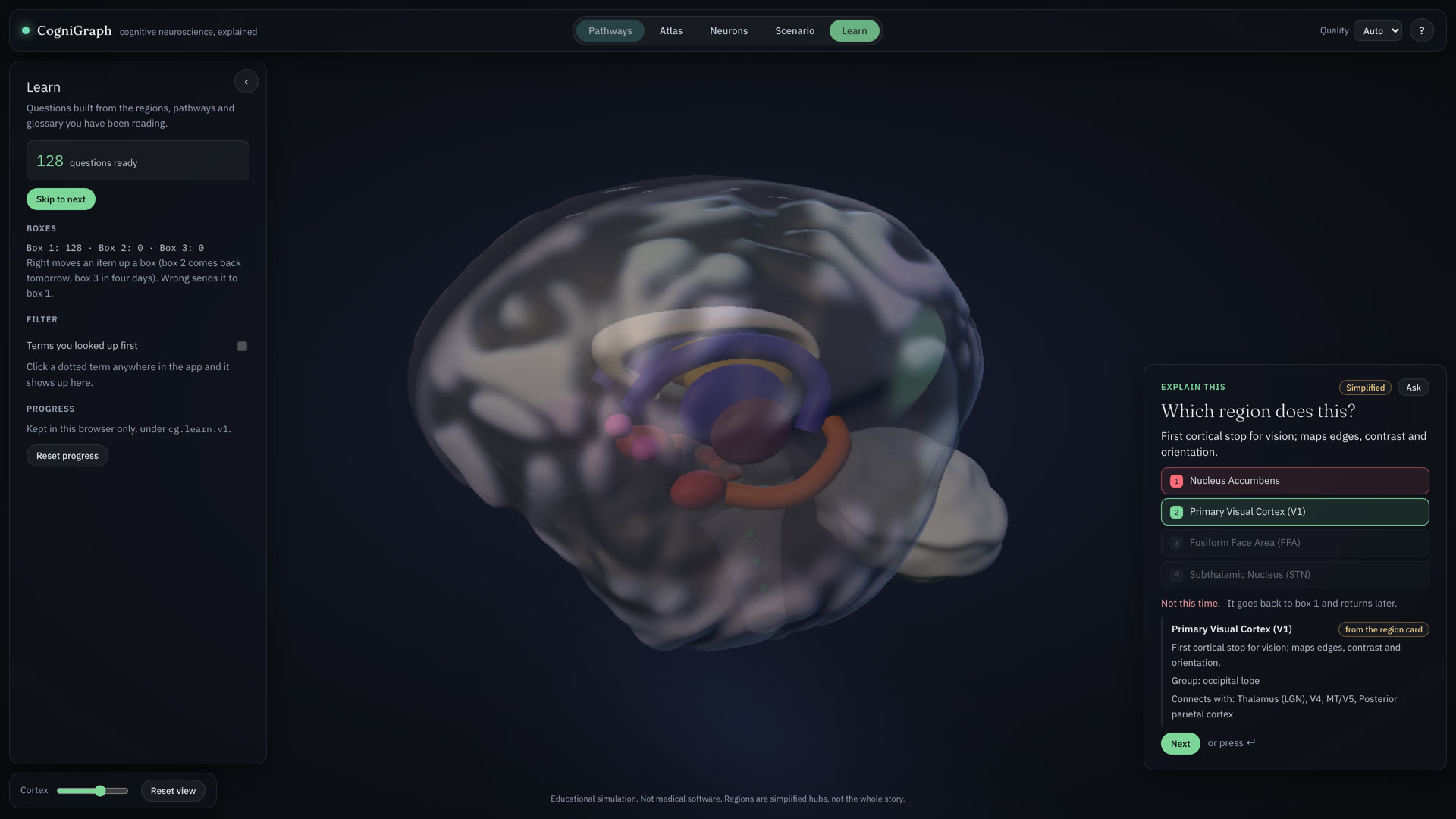
Learn mode: 128 questions ready, three Leitner boxes, and a question card asking Which region does this? with Primary Visual Cortex marked correct and the region glowing green on the brain.

Learn

Quiz yourself. Missed items come back.

Questions are built from the regions, pathways and glossary you have been reading. A right answer moves an item up a box; a wrong one sends it back to box one, and it returns sooner. Progress stays in this browser.

Try

Answer, then press Enter for the next question.

What the badges mean

Labels, not promises.

Evidence badges distinguish recordings, estimates, simplified mechanisms and metaphors. They explain how to interpret the model, not guarantee its accuracy.

What this is not. Regions are simplified hubs, not the whole story. Positions are proportional, not atlas coordinates. Colours are chosen to be told apart, not to look real. CogniGraph teaches; it does not diagnose, treat, or measure your brain.

On each pathway step · where the timing comes from

Human recordingMeasured in people, for example an EEG component such as the N170 for faces.
Animal modelTimed in animal recordings; the human latency is inferred, not measured.
EstimateA reasoned guess with no direct measurement behind it. Treat the number as a placeholder.

On each slider and explanation · how literal the model is

Direct mechanismThe knob does what the real thing does, for example GABA tone scaling inhibitory weights.
Well supportedThe effect is documented, even if the model is a simplification of it.
SimplifiedReal, but reduced to one line. Dopamine here is a knob, not a reward or learning loop.
MetaphorIllustrative only. Cortisol as a stress dial is the weakest mapping in the set, and says so.

Under the hood

One HTML file. No server.

  • BuildSource lives in small JavaScript modules. A dependency-free Python script concatenates them into a single dist/index.html, served as static files on Vercel.
  • RenderingThree.js over WebGL. The brain is procedural geometry generated in code, not a scanned or downloaded model.
  • Neurons150 Izhikevich point neurons integrated in the browser, with the raster and rate plots drawn every frame.
  • AI, optionalBring your own OpenRouter key, stored only in your browser, to unlock AI-composed scenarios and Ask. Ask answers from the app's own records and checks that its citations point at real source entries. It does not verify whether a claim is true.
  • NeedsA browser with WebGL and an internet connection for Three.js and fonts, which load from CDNs.

Try it

Open it. Press space.

No sign-up, no key, nothing to install. If you know where it is wrong, the source is open and I would like to hear it.